
Bio Pesticide Manufacturer in India | SSCL
Bio Pesticide Manufacturer in India: What to Look for and Why It Matters for Your Crops
A bio pesticide manufacturer produces crop protection products made from natural organisms - fungi, bacteria, and plant extracts - instead of synthetic chemicals. These products control pests and diseases while protecting soil health, pollinators, and the environment. In India, companies like Suraj Shree Chemicals Limited offer CIBRC-registered and IPM-compliant biopesticide formulations for sustainable agriculture.
TL;DR - Key Takeaways
- Bio pesticides are made from natural organisms and botanical extracts; they protect crops without leaving harmful residues.
- India's biopesticide market is growing rapidly as farmers shift toward sustainable and IPM-compliant farming.
- Key bio pesticide product types include neem-based formulations, fungal bio-insecticides, and beneficial bacteria — each targeting specific pest or disease challenges.
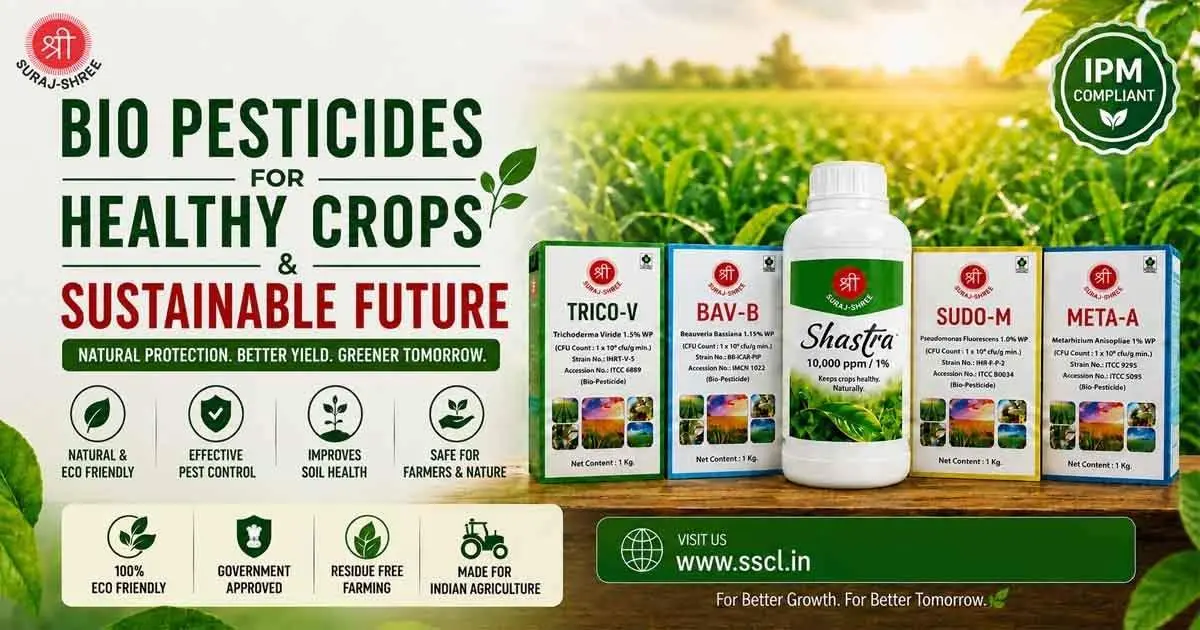
- Suraj Shree Chemicals Limited (SSCL) manufactures a complete biopesticide range — Shastra, Trico V, Sudo M, Bav B, and Meta-A — covering both above-ground pest control and soil-borne disease management. Full product details on their sustainable agriculture page.
- Choosing the right bio pesticide manufacturer means looking at product range, concentration quality, crop compatibility, and regulatory compliance.
Chemical pesticides work fast — but they leave behind residues, resistance, and collateral damage that costs farmers more over time. That is why demand for bio pesticide manufacturers in India has grown sharply over the last five years.
The Indian biopesticide market is expanding quickly, driven by growing adoption of Integrated Pest Management (IPM) and organic certification requirements. Farmers, agri-input dealers, and agribusinesses are actively looking for bio pesticide products that are effective, reliable, and compatible with modern farming systems.
But here is the problem: not every company calling itself a "bio pesticide manufacturer" delivers consistent quality, adequate concentrations, or the product range needed for different crops and pests.
This guide covers everything you need to know — how bio pesticides work, what types of products exist, how to evaluate a biopesticide company, and which products stand out for practical farm use.
What Is a Bio Pesticide Manufacturer?
A bio pesticide manufacturer is a company that formulates crop protection products using natural, living organisms or their derivatives — including fungi, bacteria, and plant-based extracts. These products suppress pests and diseases through biological mechanisms rather than chemical toxins, making them safer for the environment, residue-free, and compatible with organic farming standards.
Bio pesticides fall into three main categories:
- Microbial pesticides — products based on bacteria, fungi, or viruses (e.g., Trichoderma, Beauveria bassiana, Pseudomonas fluorescens)
- Biochemical pesticides — naturally occurring substances that control pests (e.g., Azadirachtin from neem)
- Plant-incorporated protectants (PIPs) — genetic materials added to plants themselves (less common in Indian field use)
What most articles miss about bio pesticide manufacturing is the difference between concentration and quality. Two products may both say "Trichoderma-based" on the label, but a 1 x 10⁶ CFU/g product and a 1 x 10⁸ CFU/g product will behave very differently in the field. Always verify the microbial count or active ingredient concentration before purchasing.
Why Indian Farmers Are Shifting Toward Bio Pesticide Products
Indian farmers are moving toward bio pesticides because of stricter MRL (Maximum Residue Limit) regulations, export quality requirements, rising soil degradation from chemical overuse, and government incentives under the Paramparagat Krishi Vikas Yojana (PKVY) for organic farming. Bio pesticides integrate cleanly into IPM programs and do not build up chemical resistance in pest populations.
Several factors are accelerating this shift:
1. Export market pressure
Buyers in Europe, the US, and the Middle East now require residue-free produce certificates. Farms using chemical pesticides close to harvest risk rejection at port. Bio pesticides leave no harmful residues and comply with international food safety standards.
2. Government support
The Indian government actively promotes biopesticide use through PKVY, National Mission for Sustainable Agriculture (NMSA), and Zero Budget Natural Farming (ZBNF) programs. Subsidies and technical support are available for farmers who adopt bio-based crop protection.
3. Resistance management
Pests like whiteflies and aphids have developed resistance to many common synthetic pesticides through repeated exposure. Bio pesticides — especially fungal bioinsecticides — work through different biological mechanisms, making resistance development far slower.
4. Soil health preservation
Synthetic pesticides disrupt soil microbiota over time, reducing natural fertility. Bio pesticides — especially beneficial fungi and bacteria — actively improve soil biology rather than depleting it.
SSCL's Bio Pesticide Products Range
Suraj Shree Chemicals Limited (SSCL) is a New Delhi-based bio pesticide manufacturer offering a complete portfolio of biological crop protection products for sustainable agriculture in India.
Their current biopesticide range covers both above-ground pest control and soil-borne disease management:
- Shastra — Neem-based Azadirachtin (available in 1500 ppm and 10,000 ppm concentrations) for sucking and chewing pest control
- Trico V — Trichoderma-based formulation for soil-borne disease suppression and root health
- Sudo M — Pseudomonas fluorescens for pathogen control and induced plant immunity
- Bav B — Beauveria bassiana bio insecticide for above-ground insect pest management
- Meta-A — Metarhizium anisopliae for soil-dwelling pest control including termites and white grubs
Each product is designed to work within an Integrated Pest Management (IPM) framework — either as a standalone application or in combination with other SSCL formulations for broader spectrum coverage.
For complete product details, application doses, pack sizes, and crop compatibility, visit the SSCL Sustainable Agriculture Products page.
How These Bio Pesticide Products Work Together
The most effective bio pesticide strategy combines foliar applications (Shastra, Bav B) for above-ground pest pressure with soil applications (Trico V, Sudo M, Meta-A) for root zone disease and soil pest control. This layered approach mirrors natural ecosystem defence — multiple biological mechanisms working simultaneously — which is far more resilient than any single-product treatment.
Benefits of Choosing Bio Pesticide Products
1. Zero Harmful Residues
Bio pesticides break down naturally without leaving toxic residues in soil or produce. This is critical for farms supplying to export markets or retailers with strict food safety compliance requirements.
2. Safe for Pollinators and Beneficial Insects
Synthetic insecticides routinely kill bees, parasitic wasps, and predatory insects that provide natural pest control. Bio pesticides — especially fungal and neem-based products — are highly selective, targeting only susceptible pest species.
3. Resistance Management
Pests develop resistance to synthetic chemicals through genetic selection over repeated applications. Biological control agents work through multiple simultaneous mechanisms (physical infection, hormonal disruption, enzymatic attack), making resistance development extremely unlikely.
4. Soil Biology Improvement
Products like Trico V and Sudo M actively improve soil microbiology rather than suppressing it. Healthier soil microbiota means better nutrient cycling, stronger plant growth, and higher long-term yields — not just short-term pest knockdown.
5. Compliance with Organic and IPM Standards
Bio pesticides are approved for use under India's organic farming certification programs and IPM protocols. For farmers pursuing organic certification or supplying to premium markets, bio-based crop protection is not optional — it is a prerequisite.
6. Cost-Effective Over Full Crop Cycles
The initial cost per application may be comparable to or slightly higher than some generics, but bio pesticides reduce downstream costs: fewer reapplication cycles (due to resistance), lower soil remediation costs, and fewer export rejections from residue testing.
How to Choose the Right Bio Pesticide Company
- Verify active ingredient concentration — Always ask for the CFU count (for microbials) or ppm concentration (for botanical extracts). A product with 1 x 10⁶ CFU/g is meaningfully weaker than 1 x 10⁸ CFU/g.
- Check shelf life and storage requirements — Living organisms have strict stability requirements. Poorly stored or expired products will perform poorly in the field regardless of the label claim.
- Ask about crop-specific efficacy data — Reputable bio pesticide companies will have trial data for specific crops, climates, and pest species.
- Confirm regulatory compliance — Products should be registered with the Central Insecticides Board and Registration Committee (CIBRC) of India.
- Assess product range — A complete bio pesticide product portfolio covering both insect pests (Azadirachtin, Beauveria, Metarhizium) and soil diseases (Trichoderma, Pseudomonas) indicates a serious manufacturer rather than a one-product operation.
- Evaluate technical support — Does the company provide application guidance, IPM scheduling, and crop-specific recommendations? This separates manufacturers committed to farmer outcomes from those simply moving product.
Expert Tips for Getting the Best Results from Bio Pesticides
Tip 1: Apply preventively, not reactively
Bio pesticides work best as preventive tools. Applying Trico V before sowing and Bav B at early crop stages gives biological agents time to establish before pest populations build up. Waiting until damage is visible — standard practice with chemical pesticides — dramatically reduces efficacy.
Tip 2: Combine products for broader spectrum coverage
No single bio pesticide product covers all pest and disease threats. Build a stack: Shastra for sucking pest control, Bav B for chewing insect pressure, Trico V for soil disease suppression. An integrated approach mirrors natural ecosystem resilience.
Tip 3: Mind humidity and timing for fungal bio-insecticides
Beauveria bassiana (Bav B) and Metarhizium anisopliae (Meta-A) require moisture for spore germination. Apply in the early morning or late evening when relative humidity is above 60%. Midday applications in hot, dry conditions waste product and reduce efficacy significantly.
Tip 4: Do not mix with broad-spectrum fungicides
This is one of the most common field errors. Mixing Trichoderma-based products or bacterial biocontrol agents with broad-spectrum chemical fungicides kills the beneficial organisms you just applied. Follow a separation window of at least 3–5 days between chemical fungicide application and biological product application.
Tip 5: Store correctly and use within shelf life
Living bio pesticide products have limited shelf lives and are sensitive to temperature. Store in a cool, dry place away from direct sunlight. SSCL products carry clear storage and expiry information — follow these strictly to protect product viability.
Frequently Asked Questions
What is a bio pesticide manufacturer?
A bio pesticide manufacturer produces crop protection products derived from natural sources — bacteria, fungi, plant extracts, and other biological organisms. These products control pests and diseases without synthetic chemicals, making them safe for human health, soil biology, and beneficial insects. In India, registered biopesticide manufacturers comply with CIBRC guidelines and IPM standards.
What are the main types of bio pesticide products?
The main types are microbial bio pesticides (Trichoderma, Pseudomonas fluorescens, Beauveria bassiana, Metarhizium anisopliae), botanical bio pesticides (Azadirachtin from neem), and biochemical pesticides (plant extracts with pest-disrupting properties). Each type works through a different biological mechanism and targets different pest or disease categories.
How do bio pesticides work differently from chemical pesticides?
Chemical pesticides kill pests through direct toxicity — attacking the nervous system, cell membrane, or metabolic function. Bio pesticides work through biological mechanisms: hormonal disruption (Azadirachtin), fungal infection of the exoskeleton (Beauveria bassiana, Metarhizium), competitive exclusion of pathogens (Trichoderma), and induction of plant immunity (Pseudomonas fluorescens). These mechanisms are highly specific and far less likely to harm non-target organisms.
Are bio pesticides effective enough to replace chemical pesticides?
In integrated pest management (IPM) programs, bio pesticides can replace a significant proportion of chemical inputs — especially for chronic pest pressures like soil-borne diseases and sucking insects. They are most effective when applied preventively and in combination with good agronomic practices. For severe outbreak situations, bio pesticides are typically used alongside reduced-dose chemical tools rather than as standalone replacements.
What is the cost of bio pesticide products in India?
Pricing varies by product type, concentration, and manufacturer. Microbial products (Trichoderma, Pseudomonas) typically range from ₹200–₹600 per kg. Neem-based Azadirachtin products vary significantly based on concentration — 1500 ppm products are considerably more affordable than 10,000 ppm concentrations. Over a full crop season, bio pesticides tend to deliver cost savings through reduced reapplication frequency and lower soil remediation costs. Contact SSCL for current pricing on their specific formulations.
Which bio pesticide is best for soil-borne diseases in vegetables?
Trichoderma-based products (such as Trico V) are the most widely used biological solution for soil-borne diseases in vegetables. They outcompete pathogens like Fusarium and Pythium in the rhizosphere and stimulate plant root development. For farms with recurring wilt disease or damping-off problems, combining Trico V with Pseudo M (Pseudomonas fluorescens) gives broader spectrum protection and activates the plant's own systemic resistance.
Where can I find a reliable bio pesticide company in India?
Reliable bio pesticide companies in India should be registered with the Central Insecticides Board and Registration Committee (CIBRC) and offer products with clearly stated active ingredient concentrations, shelf-life information, and crop-specific application guidelines. Suraj Shree Chemicals Limited (SSCL), based in New Delhi, manufactures a full range of biopesticide products for sustainable agriculture and can be contacted directly through their website at sscl.in.
How soon do bio pesticides show results?
Bio pesticides generally work more slowly than synthetic chemicals. Fungal bioinsecticides like Beauveria bassiana typically show pest reduction within 5–10 days, as spores need time to germinate, penetrate, and kill the host insect. Soil biological agents like Trichoderma take 2–4 weeks to establish effectively in the rhizosphere. Neem-based Azadirachtin disrupts insect development within 48–72 hours of ingestion or contact but full population suppression develops over a crop cycle.
Conclusion
India's agriculture is changing fast. Farmers are being pushed — and increasingly pulled — toward crop protection approaches that are safe, sustainable, and residue-free. The growth of bio pesticide manufacturers in India reflects this shift, not as a trend but as a structural change in how food is grown and regulated.
The key is not choosing bio pesticides over chemistry — it is choosing the right bio pesticide products for the right job, at the right time, from a manufacturer with the technical depth to back their formulations.
From neem-based Azadirachtin for insect pressure to Trichoderma for soil disease management, the product science behind modern bio pesticides is solid. The results come when farmers apply that science correctly: preventively, in combination, and with proper storage and timing.
Bio pesticide manufacturers like Suraj Shree Chemicals Limited are building the product base that makes this shift practical — not just possible.
Ready to Explore SSCL's Bio Pesticide Range?
Suraj Shree Chemicals Limited manufactures a complete portfolio of bio pesticide products designed for Indian field conditions — from neem-based formulations to fungal bioinsecticides and soil biological agents.
Visit sscl.in to explore the full sustainable agriculture product range, or contact SSCL directly at [email protected] or +91 9217707421 to discuss the right bio pesticide solution for your crop and pest situation.