
Animal Feed Supplements for Livestock | SSCL
Animal Feed Supplements: The Complete Guide for Livestock Farmers
Walk into any poultry farm or dairy shed in central India, and you'll hear the same complaint: "Feed costs are up, but animals aren't performing like they used to."
It's a genuine problem — and one that animal feed supplements are specifically designed to solve.
Soil mineral depletion, heat stress, inconsistent fodder quality — all of these quietly erode your herd's productivity. Many farmers still treat supplementation as optional. For commercial livestock production in 2025 -2026, it simply isn't.
A well-chosen animal feed supplement closes nutritional gaps that fodder and base feed cannot. It directly affects how efficiently your animals convert feed into milk, meat, or eggs — and that conversion rate determines whether a season is profitable or not.
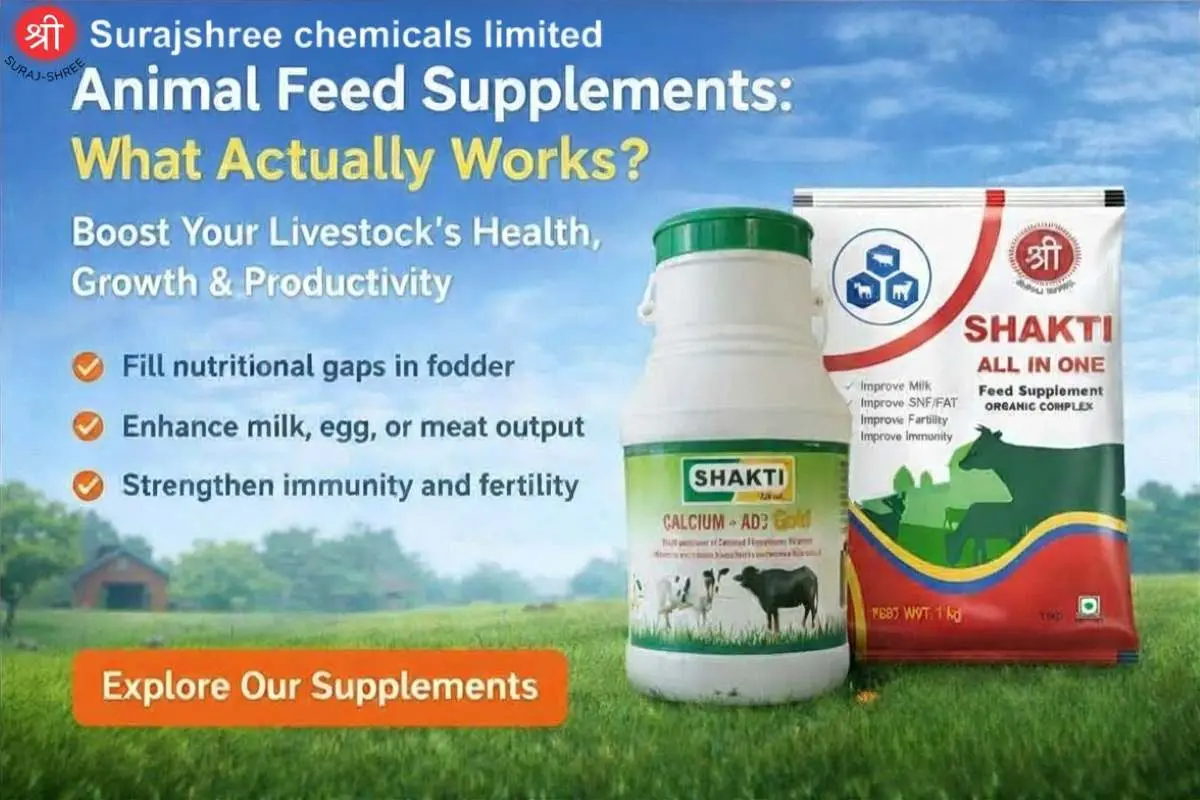
Surajshree Chemicals Limited, a manufacturer of veterinary and livestock nutrition products, has been helping Indian farmers address this challenge with targeted formulations like Liquid Calcium and Shakti All In One — developed in-house around real on-farm deficiencies, not sourced off a generic shelf.
What Is an Animal Feed Supplement?
Definition: - An animal feed supplement is a concentrated source of nutrients — including minerals, vitamins, amino acids, or a combination of these — added to standard livestock feed to correct nutritional deficiencies and support specific production goals such as milk yield, growth rate, reproduction, and immunity.
Key facts:
- Supplements work alongside base feed, not instead of it
- They are species-specific — cattle, poultry, sheep, and swine have different nutritional requirements
- They come in liquid, powder, granule, and premix forms
- The most commonly supplemented nutrients in Indian livestock are calcium, phosphorus, zinc, and vitamins A, D3, and E
- Proper supplementation can improve feed conversion efficiency by 8–15% in commercial operations
Why Nutritional Deficiencies Are More Common Than Farmers Expect
An animal can look perfectly healthy while running a nutritional deficit for weeks. The visible signs — low milk yield, rough coat, poor weight gain, reduced conception rates — often appear long after the deficiency has taken hold.
A 2022 survey of Indian dairy farms found that over 60% of crossbred cattle showed subclinical calcium deficiency during peak lactation, even in herds where farmers believed feeding was adequate.
Three reasons this happens consistently:
Fodder quality isn't predictable. Seasonal changes, drought cycles, and progressive soil mineral depletion all affect what animals actually get from grass, silage, and hay. What was nutritionally sufficient a decade ago may not be today.
High-producing animals have disproportionately high demands. A cow yielding 15–20 litres per day mobilizes calcium at a rate that no traditional feeding system was designed to support. The same applies to high-laying poultry flocks.
Stress raises the bar. Heat, disease pressure, and transportation all increase requirements for antioxidant vitamins (E, C) and trace minerals (zinc, selenium). These demands spike exactly when feed intake tends to fall.
The Critical Role of Calcium Supplementation in Dairy and Poultry
Calcium is the most in-demand mineral in livestock diets — and the most frequently underprovided.
In dairy cattle, inadequate calcium intake causes milk fever (hypocalcaemia) around calving. In its subclinical form, this affects an estimated 50% of high-producing cows in their second or later lactation. The animal doesn't collapse — it just suppresses its immune function, delays uterine involution, and produces below potential in early lactation.
In poultry, calcium directly determines eggshell quality and integrity. Laying hens need approximately 4 grams of calcium per egg produced, and that demand increases steadily as the bird ages through production.
The format of calcium supplementation matters. Liquid calcium formulations absorb faster and more completely than powder or granular options — particularly in animals under production stress where gut motility slows.
As a direct manufacturer, Surajshree Chemicals Limited formulates its Liquid Calcium in-house — controlling every stage from raw material selection to final dosage calibration. That means consistent potency, no middleman dilution, and a product optimised specifically for the high-demand windows when bioavailability matters most: pre- and post-calving, peak laying, and post-illness recovery.
Multi-Nutrient Supplements: When Single-Nutrient Products Fall Short
Deficiencies rarely arrive alone. A calcium-deficient animal is usually also low in phosphorus, vitamin D3 (which governs calcium absorption), and magnesium. Correcting one while ignoring the others gives partial results at best — and can create secondary imbalances.
This is why multi-nutrient animal feed supplements have become the preferred approach for commercial dairy and poultry operations.
A properly formulated multi-nutrient product covers:
- Macro minerals
- Trace minerals
- Fat-soluble vitamins
- Water-soluble vitamins
- Amino acids
Shakti All in One from Surajshree Chemicals Limited is manufactured to cover all of these in one calibrated formulation - removing the need to source, manage, and dose multiple single-nutrient products from different suppliers. Because it's produced in-house, the mineral and vitamin ratios are consistent batch to batch, which matters when you're building a long-term nutrition protocol for a commercial herd.
How to Choose the Right Animal Feed Supplement: 5 Key Criteria
Not every product on the market delivers what it claims. Before purchasing, evaluate against these five criteria:
1. Species specificity. A cattle mineral mix won't have the correct calcium-to-phosphorus ratio for poultry. Confirm the product is validated for your species and production stage.
2. Ingredient bioavailability. Chelated trace minerals absorb more efficiently than inorganic salt forms. For vitamins, D3 outperforms D2 in most livestock species. These differences show up in real results.
3. Clear, weight-based dosing. Products with vague directions ("use as required") are a red flag. Proper supplements carry specific dose rates per head per day or per kilogram of body weight.
4. Manufacturer credibility. Is the company an actual manufacturer or just a reseller? Direct manufacturers control formulation quality, raw material sourcing, and batch consistency — things a distributor simply cannot guarantee. Verify regulatory compliance with India's Feed Supplement and Additives (Regulation) Rules.
5. Compatibility with existing feed. Some high-calcium supplements can interfere with phosphorus absorption when layered onto already-fortified concentrate feeds. A brief consultation with the manufacturer can prevent this.
Why Choose Surajshree Chemicals Limited for Animal Feed Supplements in India?
Surajshree Chemicals Limited is a manufacturer — not a trader or distributor — of livestock and veterinary nutrition products. That distinction matters for several practical reasons:
Direct manufacturing means consistent quality. Every batch of Liquid Calcium and Shakti All In One is produced under controlled conditions, with raw material verification at intake and potency testing before dispatch. There's no third-party sourcing uncertainty in the supply chain.
Formulations built for Indian conditions. The products are calibrated for the mineral profiles typical of Indian fodder, the heat load of Indian climates, and the nutritional demands of crossbred cattle and commercial poultry breeds common across Maharashtra, Gujarat, Madhya Pradesh, and beyond.
Liquid Calcium — fast-absorbing, manufacturer-direct, designed for peak-demand periods when slower formats can't keep pace with the animal's requirements.
Shakti All In One — a complete multi-nutrient supplement manufactured in-house, covering all key minerals and vitamins in one dose across all production stages.
Competitive pricing without the middleman. Buying directly from the manufacturer means you're not paying distributor margins on every order — a real saving when supplementation is a year-round operational cost.
Real-World Application: A Maharashtra Dairy Farm Case
A 40-cow crossbred dairy operation in Maharashtra with average production of 14 litres per cow per day was running on a standard green fodder plus concentrate diet. Feeding looked broadly adequate on paper. But the herd was consistently showing third-trimester and early-lactation problems: retained placenta, delayed return to estrus, and first-cycle yields below target.
Blood mineral screening showed subclinical hypocalcaemia in 55% of animals and borderline zinc status across the herd.
Intervention: Liquid Calcium supplementation from three weeks pre-calving through week four of lactation, combined with Shakti All In One across the full herd year-round.
Results over two lactation cycles:
- Retained placenta incidents dropped from 7 to 2 per cycle
- Average peak milk yield increased by 1.8 litres per cow per day
- First conception rate improved from 58% to 74%
These improvements came from correcting what was already broken — not from any change to the base feeding program.
Key Takeaways
- Animal feed supplements correct deficiencies that fodder and concentrates cannot fully address on their own
- Calcium is the most critical mineral in dairy cattle and laying poultry nutrition — and the most commonly deficient in Indian herds
- Liquid formulations absorb faster than powder forms, making them more effective during high-stress production periods
- Multi-nutrient supplements like Shakti All In One reduce complexity and the risk of imbalanced single-nutrient stacking
- Supplementation timing matters — calving, early lactation, and peak laying are the highest-risk windows
- Visible health problems often lag weeks or months behind the start of a nutritional deficit — don't wait for symptoms
- Buying from a direct manufacturer ensures batch-to-batch consistency and eliminates middleman quality risk
Frequently Asked Questions About Animal Feed Supplements
What is an animal feed supplement and what does it do for livestock?
An animal feed supplement is a concentrated source of nutrients — minerals, vitamins, amino acids, or a combination — added to standard livestock feed to correct deficiencies and support production goals. It works alongside regular feed, not instead of it. The right supplement improves milk yield, growth rate, immunity, reproduction, and feed conversion efficiency when matched correctly to the species and production stage.
How is liquid calcium different from powder calcium for dairy cattle?
Liquid calcium absorbs faster and more completely than powder or granular calcium, particularly during high-demand periods like calving or peak lactation when digestive function is under stress. It's also easier to dose accurately. For animals already showing signs of deficiency — or during the pre-calving transition — liquid calcium corrects the deficit more rapidly than slower-absorbing powder alternatives.
When should dairy cattle receive calcium supplementation?
Calcium supplementation is most important during the transition period — roughly three weeks before calving through the first four weeks of lactation. This is when calcium demand is highest and when subclinical deficiency most commonly causes retained placenta, milk fever, and suppressed early milk production. High-yielding crossbred herds often benefit from year-round supplementation at maintenance levels outside this window.
Can one multi-nutrient supplement replace several individual mineral products?
For most farm situations, yes. A well-formulated product like Shakti All In One covers macro minerals, trace minerals, and vitamins in one dose — simpler to manage, less risk of imbalance, and usually more cost-effective per animal per day than stacking individual products. For acute clinical deficiencies such as active milk fever, a targeted product like Liquid Calcium may still be needed alongside the multi-nutrient base.
Are animal feed supplements safe to use across different livestock species?
Supplement formulations are species-specific. A mineral mix designed for cattle will have different calcium-to-phosphorus ratios than one designed for poultry, and cross-species use can cause imbalances. Always verify a supplement is formulated and approved for your species. Fat-soluble vitamins and certain trace minerals can cause toxicity if overdosed, so following manufacturer dosing guidance precisely is important.
Ready to Optimize Your Livestock's Nutritional Program?
Nutritional deficiencies cost Indian farmers money every season — in lost milk yield, poor conception rates, compromised immunity, and avoidable treatment costs. Most of those losses are preventable with the right supplementation protocol in place.
Surajshree Chemicals Limited manufactures animal feed supplements built specifically for Indian livestock conditions. Buying direct from the manufacturer means consistent quality, transparent formulation, and pricing without distributor margins.
Whether you manage a dairy herd at peak lactation, a commercial poultry flock, or mixed livestock at different production stages, their technical team can help you identify exactly what your animals are missing — and build a supplement program around that.
Contact Surajshree Chemicals Limited today to discuss your herd's nutritional requirements and get a direct-from-manufacturer recommendation matched to your operation.
Explore Liquid Calcium and Shakti All In One product specifications to understand the formulation, dosing, and how each fits your current feeding program.
Request a farm nutrition consultation and find out exactly where your current feeding program may be leaving productivity — and money — on the table.